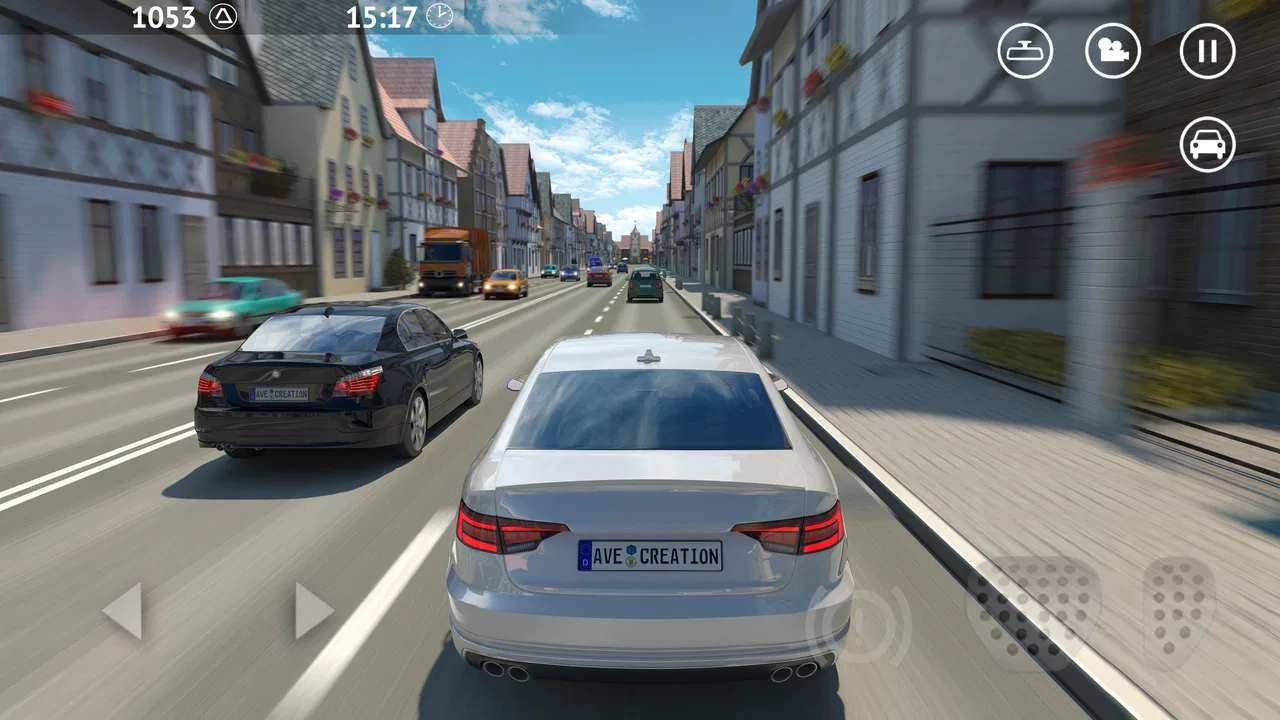
Driving Zone: Germany
- 4.4
- Rating
- 10.00M
- Installs
- Free
- Price

 Analysis by App-foxy
I approached Driving Zone: Germany expecting a straightforward mobile racing game, but its appeal is a little more specific than that. Developed by AveCreation, it focuses on driving German cars through a street-racing and simulator-style experience rather than building a huge career around licenses, championships, or a long story. That makes it easy to understand from the first launch: choose a car, get onto the road, and concentrate on how the vehicle responds.
After spending time with it, I see it as a good fit for players who enjoy relaxed driving with a racing edge. It is free to start, rated Everyone, and has reached over ten million installs, so it is clearly aimed at a broad mobile audience. The average rating of 4.3 from around 166 thousand ratings also matches my impression: this is a well-liked, accessible game, although it will not satisfy everyone looking for a deep console-style racing career.
What the first drive feels like
The most important thing to understand is the mood of the game. This is not primarily about memorizing a complicated upgrade tree or completing a sequence of dramatic events. The pleasure comes from controlling a car, finding a comfortable rhythm on the road, and seeing how carefully you can drive when traffic, speed, and steering all compete for attention.
You May Also Like

 Blood Strike: 2.5 Anniversary
Blood Strike’s Loadouts Turn Every Drop Into a Tactical Gamble
A close look at Blood Strike’s custom loadouts: how fast access to signature weapons reshapes its battle royale rhythm, rewards preparation, and narrows the gap between fights.

 Pandora - Music & Podcasts
Pandora’s Music Is Easy to Start, but Harder to Recover
Pandora’s strength is its low-effort path from a seed to a station. Its weak spot is how much confidence it asks you to place in connection, setup, and quiet recovery.

 8 Ball Pool
 Is Built on Rivalries, Rematches, and Routine
A close look at the rivalries, rematches, shared routines, and unanswered safety questions that turn a quick pool match into a persistent mobile community.

 Samsung Music
’s Quiet Strength Is Playing What You Already Own
Its reach comes less from spectacle than from dependable access to a personal library. That simplicity is both the app’s strongest retention engine and its ceiling.

 AccuWeather: Weather Radar
AccuWeather Review: A Quick, Clear Forecast for Everyday Decisions
For everyday plans, the best forecast is the one you can understand quickly. AccuWeather makes rain timing, radar, and local conditions easy to act on, with a few trade-offs.

 Hill Climb Racing
Why Hill Climb Racing Still Turns Crashes Into One More Run
A tiny car, a bumpy hill and one more upgrade: Hill Climb Racing keeps resurfacing because its simple chaos makes every near-miss feel personal.
More From Our News Desk



That simulator influence changes the way I play. In a typical arcade racer, I expect to throw the car into corners, recover instantly, and treat collisions as a minor interruption. Here, I get more enjoyment when I make smoother inputs and leave myself enough room to react. Even when I am not chasing a perfect run, the game gives me a reason to pay attention to braking, lane position, and the timing of a pass.
The German-car focus gives the presentation a clear identity. Instead of feeling like a random collection of vehicles, the game is built around a recognizable automotive theme. I would recommend it to someone who likes the idea of driving familiar European-style performance cars but does not want a demanding simulation with a wheel, pedals, or a long tutorial.
It is also worth setting expectations about variety. The experience is narrower than a large racing package with many disciplines. If your priority is off-road competition, kart racing, licensed motorsport events, or a story-driven campaign, another racing game will probably suit you better. Driving Zone: Germany works best when you want a compact driving session that can begin quickly and still reward careful control.
Choosing the right mindset before installing
I would install it for short sessions after work, while waiting for an appointment, or when I want something more involved than an endless runner but less demanding than a full racing simulator. A realistic everyday use case is a ten-minute drive: I start with no goal beyond getting comfortable, then turn the session into a small challenge by trying to maintain a clean line and avoid rushed decisions.
That approach is more satisfying than immediately treating every road as a drag strip. The game’s street setting invites experimentation, but the simulator angle makes reckless inputs less rewarding. My first useful tip is to begin slowly, learn the steering response, and only increase the pace once the car feels predictable. This saves frustration and makes the first successful run arrive much sooner.
The game is free, but optional purchases range from seventeen cents to $26.99 per item. I would not make a purchase during the first session. The better decision is to learn whether the driving feel suits you before spending anything, because no amount of extra content can fix a control style you simply do not enjoy.
From installation to your first meaningful success
I use this section to make the first session feel manageable: rather than chasing speed, I focus on one clear aim, keeping the car steady through a stretch of road. That gives me a useful baseline for judging the handling and deciding whether any control adjustment is actually needed. With that first win in place, the next section looks at the habits that can make an otherwise approachable drive feel unexpectedly difficult.
Start with a calm setup
On Android, the listed minimum operating system is 7.1. That makes the entry point fairly approachable for people using an older compatible device, although the actual comfort of play will still depend on the phone or tablet’s performance and screen size. I prefer beginning with the device charged, notifications silenced, and enough time for one uninterrupted attempt. Racing controls are much easier to judge when the screen is not being interrupted.
At launch, resist the urge to change everything at once. First identify how steering, acceleration, and braking feel with the default arrangement. If you alter several controls before driving, it becomes difficult to know whether a mistake comes from your technique or from the layout. I make one short test run, note what feels awkward, and then change only the control that is genuinely causing trouble.
Touch controls are convenient, but they require a lighter hand than many new players expect. Pressing harder does not make the car more precise. I use small movements, release the input before a corner rather than during it, and avoid holding a steering direction longer than necessary. This is one of the quickest ways to make the game feel less slippery.
If your device has a small display, keep your attention on the road instead of trying to monitor every on-screen element continuously. The first session is about building a reliable visual habit: look ahead, identify where the road is opening or tightening, and then make the input. Watching the car too closely can make you react late.
Make the first successful run deliberately simple
My recommended first objective is not maximum speed. It is completing a clean stretch of driving without panicking when the road changes. Start by holding a stable line, use gentle acceleration, and treat every corner as a chance to learn rather than a test you must win. Once you can do that consistently, faster driving becomes a natural next step instead of a gamble.
One useful technique is to separate the actions in your head. Brake or ease off before the turn, steer through the bend, and accelerate only when the car is pointing toward the exit. New players often combine all three actions at once, which makes the vehicle feel unpredictable. Separating them gives you a clearer sense of what the physics are doing.
Another practical tip is to leave more space than you think you need when passing. A narrow opening may look tempting, but a simulator-oriented game punishes rushed positioning more than an arcade racer would. Wait for a cleaner opportunity, make one decisive movement, and return to a stable line afterward. That habit is useful even when you later decide to drive aggressively.
Your first meaningful success should be a run where you finish feeling in control, not necessarily one where you drive at the highest possible speed. I found that this changes the game from a trial-and-error activity into a small driving practice. Once the controls become familiar, I can focus on improving consistency, choosing better moments to pass, and making each run feel intentional.
Why the physics matter more than the label
The word “simulator” can mean very different things on mobile. Here, I would interpret it as a stronger emphasis on believable handling and road awareness, not as a promise of a complete professional driving model. The game remains approachable, and that balance is one of its strengths. I can enjoy the sensation of managing a car without needing to study technical vehicle settings before I begin.
This also explains why the game may feel slower at first than an arcade alternative. The reward is in making fewer corrections, not simply tapping the accelerator and hoping the car stays pointed forward. If you prefer instant boosts, exaggerated jumps, and constant visual effects, the first minutes may seem restrained. If you like noticing how a small steering adjustment changes the line, the same restraint becomes the main attraction.
Common confusion that can make the game feel harder
I find that most early frustration comes from treating every mistake as a sign that the controls or car are wrong. I cover how to tell a learning curve from a genuine setup problem, and why changing several things at once can make it harder to improve. Once those sources of confusion are easier to separate, it becomes simpler to decide what to try next.
Speed is not the same as progress
A common mistake is assuming that every session should be a high-speed attack. I made that mistake early on and found that the game became more frustrating than it needed to be. When I slowed down, I could see the road better, anticipate turns, and understand why a particular input caused the car to drift away from the line I wanted.
Think of the opening sessions as calibration. You are learning the relationship between your thumb and the vehicle. A run that looks modest on paper can still be valuable if it teaches you how early to steer or when to release acceleration. This is especially important for first-time players who arrive from arcade racers with very forgiving handling.
Do not change controls to solve a driving mistake
It is tempting to blame the layout whenever a corner goes wrong. Sometimes the arrangement really is uncomfortable, but changing it after every failed attempt creates a moving target. I recommend keeping one setup long enough to develop muscle memory. Only adjust it when the same problem appears repeatedly, such as accidentally touching the wrong control or blocking your view with a thumb.
This is a small but useful trade-off: a familiar layout is usually better than a theoretically perfect one. The best controls are the ones you can use without looking down. Once that happens, your eyes can stay on the road and your reactions become calmer.
In-app purchases should be treated as optional decisions
Because the game is free, some players may wonder whether they need to spend money to enjoy it. My advice is to play first and decide later. The purchase range is wide, and the top end is significant enough that an impatient purchase could cost more than expected. I would only consider buying something after identifying a specific reason, such as wanting to support the developer or extend the way I already play.
Do not buy simply because the opening drive feels unfamiliar. Early difficulty is more likely to come from learning the controls than from lacking an item. Giving yourself a few sessions to build confidence is the most sensible way to judge the game’s value.
Understand what it is not trying to replace
Compared with a mainstream arcade racer, Driving Zone: Germany feels more grounded and less focused on spectacle. Compared with a serious simulator, it is easier to pick up and better suited to casual mobile play. That middle position is useful, but it also means specialists may find it limited. Players wanting a deep tuning laboratory, structured competitive events, or a large narrative progression should look elsewhere.
I also would not choose it for children solely because the age rating is Everyone. The rating makes it broadly accessible, but the driving style still benefits from patience and concentration. A younger player who wants immediate action may prefer a simpler arcade game, while someone who enjoys learning through repetition may appreciate this one.
How to keep improving after the first drive
Once the basic controls feel comfortable, give each session a single purpose. One day I might focus on smooth cornering; another time I might practice safer overtakes. This is more effective than trying to improve everything simultaneously. It also keeps short sessions interesting because there is always a clear question to answer: can I make this section cleaner than before?
A particularly useful workflow is to repeat the same type of mistake consciously. If I run wide in bends, I do not simply restart and hope for better luck. I reduce speed earlier, use a smaller steering input, and watch whether the exit improves. That turns failure into feedback. The game is at its best when I treat it like a driving exercise rather than a sequence of random attempts.
After that, experiment with pace. Drive one run conservatively, then increase the speed gradually while preserving the same line. This reveals the point where your control becomes rushed. Knowing that limit is more useful than chasing a single spectacular run because it helps you decide when to back off before a mistake becomes unavoidable.
Players who enjoy car-focused games may also appreciate comparing different driving habits rather than only comparing vehicles. Ask yourself whether you prefer smooth and safe progress or a more aggressive style with greater risk. The game gives room for both approaches, but the simulator influence makes the first option easier to repeat consistently.
The current version is 1.25.791, and the game has been available since May 27, 2017. Those details place it among the more established mobile racing experiences rather than a brand-new experiment. For me, that matters less as a badge of age than as a reminder to judge it on its focused driving loop: it is designed around the road, the car, and the feel of control.
Who should download it
I would recommend it to someone who wants a free racing game with German cars, street driving, and a more measured handling style. It is especially suitable if you enjoy improving through repetition, prefer short sessions, and want a game that can be understood without a long explanation. The first meaningful achievement is simply learning to complete a clean drive, and that makes the entry point reassuring for beginners.
I would skip it if your ideal racing game is all about constant boosts, dramatic crashes, licensed tournament structures, or an extensive story. I would also choose another option if you need a highly technical simulation with detailed setup work. This game sits between those extremes: more thoughtful than a purely arcade racer, but more accessible than a dedicated simulator.
For a friend asking whether it is worth trying, my answer would be yes, with one condition: approach it as a driving game first and a speed game second. Install it, keep the first setup simple, learn the controls through a calm run, and wait before considering any purchase. The real strength is the satisfying transition from nervous steering to deliberate driving. Once that clicks, the focused design becomes enjoyable rather than restrictive.
My final view is positive because the game knows what kind of experience it wants to provide. AveCreation keeps the attention on German cars, street movement, and real-feeling control instead of burying the drive under unnecessary complexity. It has limitations, particularly for players seeking broad racing variety, but within its lane it offers a pleasant and approachable way to spend a few minutes. For me, that is enough to keep it installed when I want a quieter, more controlled alternative to the usual mobile racing rush.
FAQs for Driving Zone: Germany
01What is the main objective of Driving Zone: Germany?
Driving Zone: Germany is a driving simulator that immerses players in a realistic German environment. The main objective is to navigate through various streets and highways, testing your driving skills in different weather conditions and times of day. Players can choose from a wide range of German cars, each with unique handling and performance characteristics.
02What are the system requirements for Driving Zone: Germany?
The game requires an Android or iOS device with at least 2GB of RAM for optimal performance. For Android, a version of 4.1 or higher is necessary, while iOS users need iOS 9.0 or later. Ensure your device has sufficient storage space available, as the game file is relatively large.
03Does Driving Zone: Germany offer in-app purchases?
Yes, Driving Zone: Germany includes in-app purchases. While the game is free to download and play, players have the option to purchase additional vehicles, upgrades, and customization options. These purchases can enhance gameplay but are not mandatory for enjoying the core experience.
04Can I play Driving Zone: Germany offline?
Driving Zone: Germany can be played offline, allowing users to enjoy the game without an internet connection. However, certain features, such as leaderboards and some in-app purchases, require an online connection to function. Playing offline is ideal for uninterrupted gameplay on the go.
05Is Driving Zone: Germany suitable for all ages?
Driving Zone: Germany is suitable for a wide range of ages, but it is recommended for players aged 12 and up due to its realistic driving mechanics and mild in-game ads. There is no explicit content, making it a family-friendly option for those interested in driving simulators.
Pros
- Realistic driving physics enhance gameplay.
- Wide variety of German cars to choose from.
- Dynamic weather changes add to realism.
- Detailed German environments are immersive.
- Customizable controls for personalized play.
Cons
- Limited multiplayer options available.
- In-app purchases can be expensive.
- Graphics can be demanding on older devices.
- Repetitive missions may reduce replay value.
- Occasional bugs affect game stability.

Driving Zone: Germany
Gallery